Say Goodbye to Shoulder Pain with SurgiPartner Rotator Cuff Repair
Restore Shoulder Strength. Relieve Pain. Regain Full Arm Movement
Rotator Cuff Repair Surgery in Hyderabad — Arthroscopic Shoulder Tear Treatment
The rotator cuff is the group of four muscles and tendons that stabilise the shoulder joint and enable a full range of arm movement. Rotator cuff tears are one of the most common shoulder conditions — causing pain, weakness, and restricted movement that can significantly impair daily activities and sports participation. SurgiPartner connects patients in Hyderabad with specialist shoulder surgeons for arthroscopic rotator cuff repair, with excellent long-term outcomes.


The Rotator Cuff — Anatomy and Function
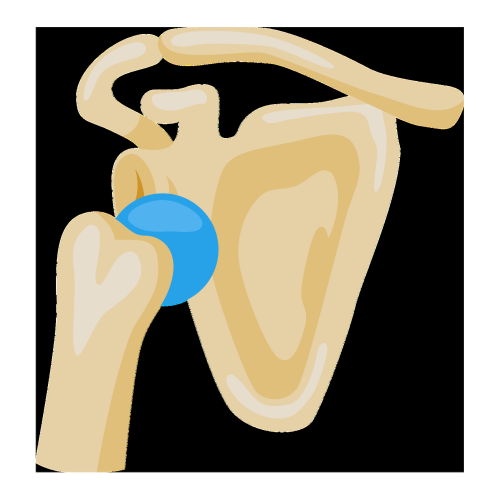
The rotator cuff consists of four muscles originating from the scapula (shoulder blade) and attaching via tendons to the head of the humerus (upper arm bone):
- 1. Supraspinatus — initiates shoulder abduction (lifting the arm away from the body). Most commonly torn rotator cuff tendon
- 2. Infraspinatus — external rotation of the arm. Second most commonly torn
- 3. Teres minor — external rotation and adduction
- 4. Subscapularis — internal rotation. Least commonly torn; significant functional consequences when torn
Together, these four muscles stabilise the glenohumeral joint (shoulder ball and socket), keep the humeral head centred in the glenoid socket, and power nearly all arm movements. Loss of rotator cuff integrity through tearing leads to pain, weakness, and progressive shoulder dysfunction.
Types of Rotator Cuff Tears
By Thickness
- Partial thickness tear — only part of the tendon’s thickness is torn; the tendon remains attached to the bone. May be articular-sided (joint side), bursal-sided, or intratendinous. Partial tears may progress to full thickness over time.
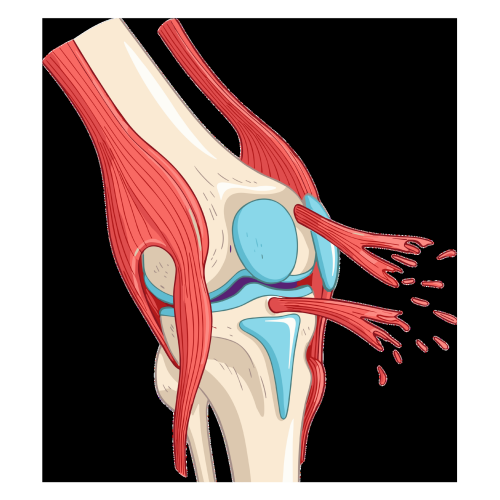
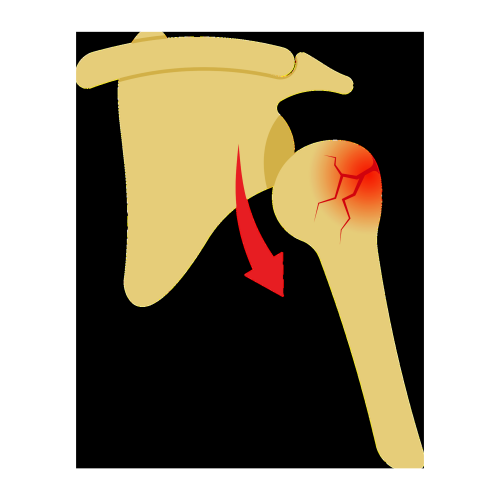
- Full thickness tear — the tendon is completely torn through, creating a hole. Varies from small (less than 1 cm) to massive (greater than 5 cm or involving multiple tendons).
By Size (Full Thickness)
| Classification | Size | Typical Management |
|---|---|---|
| Small | <1cm | Conservative or arthroscopic repair |
| Medium | 1–3cm | Arthroscopic repair (excellent outcomes) |
| Large | 3–5cm | Arthroscopic repair (experienced surgeon) |
| Massive | >5cm or 2+ tendons | Arthroscopic repair ± augmentation, or superior capsule reconstruction |
By Cause
- Degenerative tears — gradual tendon wear and tear with ageing. Most common type; typically occurs in patients over 40. The supraspinatus tendon’s “critical zone” (an area of relative avascularity) is particularly vulnerable.
- Acute traumatic tears — sudden, forceful injury such as a fall on an outstretched arm, sudden heavy lifting, or shoulder dislocation. Can occur in younger patients with healthy tendon tissue.


Symptoms of Rotator Cuff Tear
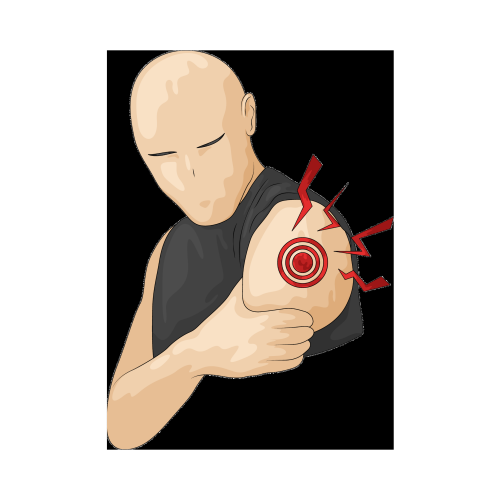
- Shoulder pain — typically located in the outer shoulder and upper arm; worsens with overhead activity, reaching behind the back, and lying on the affected side at night
- Night pain — characteristic of rotator cuff pathology; disturbs sleep significantly
- Weakness — difficulty raising the arm overhead, carrying objects, or performing overhead sports
- Limited range of motion — particularly abduction and external rotation
- Crepitus — crackling or grinding sensation in the shoulder with movement
- Pseudoparalysis — in massive tears, inability to actively raise the arm despite passive range of motion being maintained
Diagnosis of Rotator Cuff Tears
- Clinical examination — Jobe’s test (empty can test) for supraspinatus; Hornblower’s test for infraspinatus; Gerber’s lift-off test for subscapularis; Neer and Hawkins impingement signs
- MRI shoulder — gold standard; precisely characterises tear size, location, tendon retraction, and muscle atrophy (fatty infiltration grading)
- Ultrasound shoulder — dynamic, real-time evaluation of tendon integrity; operator-dependent but excellent in experienced hands
- X-ray shoulder — assesses acromion morphology, AC joint, and bony changes; superior migration of the humeral head in massive tears
Rotator Cuff Treatment — Conservative and Surgical Options
Conservative Treatment
Appropriate for: partial thickness tears, small full thickness tears in older or sedentary patients, and patients unfit for surgery. Includes: physiotherapy with rotator cuff strengthening and scapular stabilisation, NSAIDs, subacromial corticosteroid injections (1–3 injections) for symptom relief, and activity modification. Conservative treatment successfully manages symptoms in 50–60% of partial tears and smaller full thickness tears without surgery.
Arthroscopic Rotator Cuff Repair
Surgical repair is recommended for: full thickness tears causing significant symptoms in active patients, large or massive tears, acute traumatic tears in younger patients, and tears failing conservative management. Arthroscopic repair uses suture anchors — small titanium or biodegradable devices inserted into the humeral bone — to reattach the torn tendon back to its footprint on the greater tuberosity.
Modern double-row suture anchor constructs recreate the anatomical footprint of the supraspinatus tendon, providing superior fixation strength and healing rates (85–90% for small to medium tears). The procedure is performed under general anaesthesia with an interscalene nerve block for post-operative pain control. Hospital stay is 1 night; arm is placed in a sling for 4–6 weeks post-operatively.
Frequently Asked Questions — Rotator Cuff Repair Hyderabad
Why Choose SurgiPartner?
Choosing SurgiPartner means choosing trusted shoulder care with orthopedic expertise.
01.
Expert Shoulder & Orthopedic Surgeons
Our specialists have extensive experience in treating complex shoulder injuries and rotator cuff tears.
02.
Arthroscopic Technology
We use modern arthroscopy systems for precise, minimally invasive tendon repair.
03.
Personalized Treatment Plans
Each patient receives a customized surgical and physiotherapy plan for optimal recovery.
04.
Pain-Controlled & Faster Recovery
Most patients experience reduced pain and gradual return to activities within weeks.
Book Your Consultation
Take the first step toward pain-free shoulder movement with SurgiPartner rotator cuff repair surgery. Our experts are here to guide you through safe, precise, and effective shoulder care.
Strong shoulders. Free movement. Better life.
View SurgiPartner on Google

Posted on Google
 saikiran challa
Trustindex verifies that the original source of the review is Google.
I am thoroughly impressed with the SurgiPartner model, which delivers integrated, end-to-end patient support across the healthcare continuum—from initial consultations to treatment and surgical interventions, where necessary. I recently availed their Care Buddy service for a consultation, and the experience was highly seamless, efficient, and professionally managed. The structured Care Buddy support, combined with well-aligned financial assistance processes, significantly enhances the overall patient journey. This holistic and patient-centric approach effectively streamlines access to quality healthcare, making it more efficient and convenient in today’s dynamic environment.Posted on Google vasantha kumari buggalaI’m really impressed with the SurgiPartner concept. They provide end-to-end patient support—from doctor consultations to treatment and even surgery when required. I personally used their Care Buddy service for a consultation, and it was a smooth and positive experience. The Care Buddy assistance, along with support in financial processes, makes healthcare much more convenient, especially in today’s fast-paced lifestyle.Posted on Google
 krishna nayakMy Brother Arun Kumar and krishna from Bangalore. We are travelled to Hyderabad for LASIK surgery, and today we successfully underwent the procedure at American Laser Eye Hospital. The surgery went very smoothly and I am feeling very good after the procedure. The hospital environment is very clean and well maintained. All the staff and doctors are very polite, supportive, and professional. A special thanks to SurgiPartner CareBuddy for guiding and helping me throughout the entire process. From the beginning till the end of the day, they were with us at every step and provided excellent support. Overall, I had a very good experience and I highly recommend American Laser Eye Hospital for LASIK surgery with SurgiPartner support.Posted on Google
 ManaswiReally impressed with the concept of SurgiPartner. They offer complete patient support from doctor consultation to treatment and surgery if needed. I personally took a consultation through their Care buddy, and it was a great experience. The care buddy system and help with financial processes make healthcare much easier, especially in today’s busy world.Posted on Google
 Arun NayakMy name is Arun Kumar and I am from Bangalore. I traveled to Hyderabad for LASIK surgery, and today I successfully underwent the procedure at American Laser Eye Hospital. The surgery went very smoothly and I am feeling very good after the procedure. The hospital environment is very clean and well maintained. All the staff and doctors are very polite, supportive, and professional. A special thanks to SurgiPartner CareBuddy for guiding and helping me throughout the entire process. From the beginning till the end of the day, they were with us at every step and provided excellent support. Overall, I had a very good experience and I highly recommend American Laser Eye Hospital for LASIK surgery with SurgiPartner supportPosted on Google
 Shankar S ShankruThank you for the support and service provided by SurgiPartner. The overall experience was smooth and the team was very helpful.Posted on Google
 Thejasree KStaff is very good and nice receiving. They are very humble and their response is very good. Thank youPosted on Google
 Srihari ReddyI want to thank Surgipartner for all the help and support during my LASIK surgery. From the beginning till the end, the team was very proactive with follow-ups and guided me clearly through every step, which made the whole experience easy and stress-free. I would especially like to appreciate CareBuddy Raju and Coordinator Anusha for their outstanding support. They were always in touch with both the hospital staff and me, helped reduce waiting time, and made sure everything went smoothly. Their care, quick responses, and constant guidance really made a big difference. Overall, I had a very positive experience and truly appreciate the support provided by Surgipartner.Verified by TrustindexTrustindex verified badge is the Universal Symbol of Trust. Only the greatest companies can get the verified badge who has a review score above 4.5, based on customer reviews over the past 12 months. Read more
How SurgiPartner Supports You — From First Call to Full Recovery
Follow your step-by-step guide to a successful surgery and recovery, with our expert team supporting you all the way.
Find Doctor & Hospital Support
Fill in your details and we'll call you back to confirm your slot.