Say Goodbye to Hip Pain with SurgiPartner Hip Replacement Surgery
Experience Smooth, Pain-Free Movement with Precision Orthopedic Care
Hip Replacement Surgery in Hyderabad — Total Hip Replacement
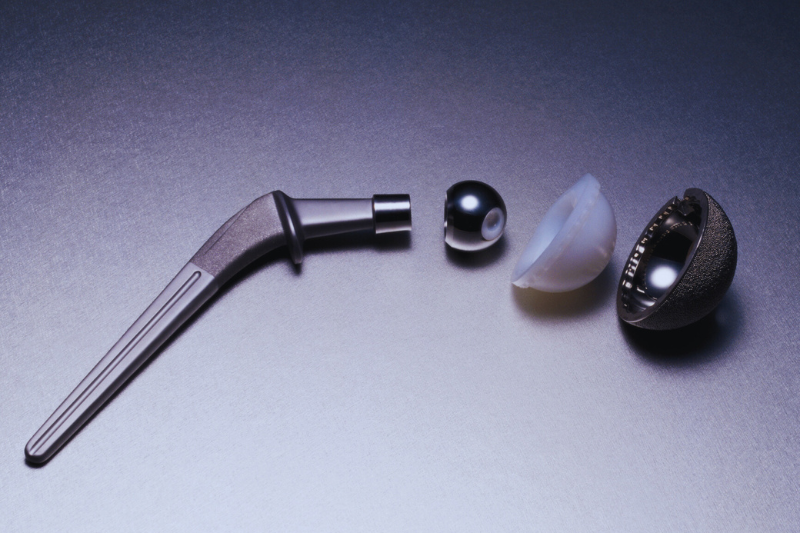
Hip replacement surgery (hip arthroplasty) is a transformative procedure that removes the damaged hip joint and replaces it with an artificial implant — eliminating chronic hip pain, restoring mobility, and allowing patients to return to walking, climbing stairs, and enjoying life free from the debilitating pain of advanced hip arthritis. SurgiPartner connects patients across Hyderabad with expert hip replacement surgeons at multiple partner hospitals.
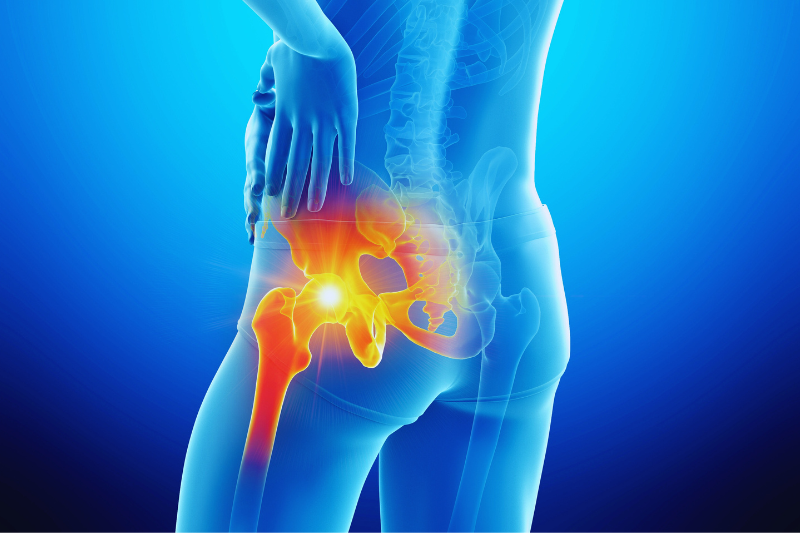
The Hip Joint — Understanding Why It Wears Out
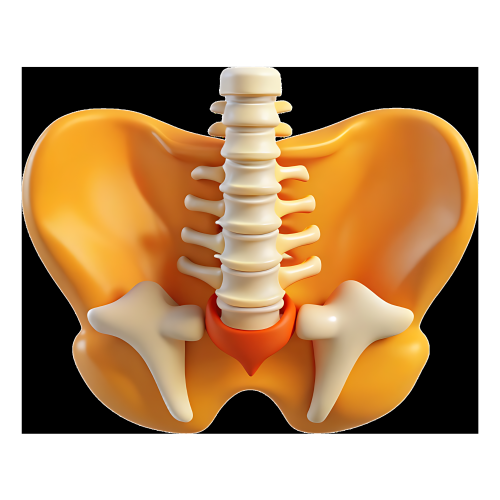
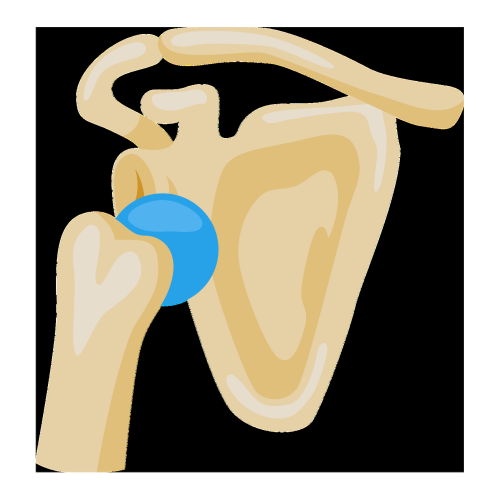
The hip is a ball-and-socket joint where the femoral head (ball at the top of the thigh bone) articulates with the acetabulum (socket in the pelvis). Articular cartilage provides smooth, friction-free movement. When this cartilage degrades through arthritis, injury, or avascular necrosis, bone rubs against bone, causing severe, progressive pain that ultimately makes walking extremely difficult.
Hip replacement surgery in nearby areas
Conditions Requiring Hip Replacement
- A. Osteoarthritis — most common indication; progressive cartilage loss affecting 1 in 4 adults over 55
- B. Avascular Necrosis (AVN / Osteonecrosis) — common in India; associated with steroid use, alcohol, sickle cell disease, and trauma. The femoral head loses blood supply and collapses. Very common in young adults (30–50 years)
- C. Rheumatoid Arthritis — inflammatory joint destruction; hip replacement often required at younger age than in OA
- D. Femoral neck fracture — hip replacement (hemiarthroplasty or THA) is standard treatment for displaced femoral neck fractures in elderly patients
- E. Developmental Dysplasia of the Hip (DDH) — malformed hip socket causes early arthritis; requires complex acetabular reconstruction at replacement
- F. Post-traumatic arthritis — following hip fractures or dislocations
Surgical Approaches to Hip Replacement
| Approach | Position | Muscles Cut? | Advantages | Disadvantages |
|---|---|---|---|---|
| Posterior Approach | Lateral | Short external rotators | Excellent exposure; most versatile | Higher dislocation risk without precautions |
| Anterior (DAA) | Supine | None — muscle-sparing | Fastest recovery; lowest dislocation risk; natural position | Technically demanding; limited exposure in obese |
| Lateral (Hardinge) | Lateral | Partial gluteus medius | Very low dislocation risk | Abductor weakness risk |
The Direct Anterior Approach (DAA) is increasingly the preferred technique — it is a true muscle-sparing approach with no muscles cut, resulting in faster rehabilitation, reduced post-operative pain, and the lowest dislocation risk.
Hip Implant Types — Choosing the Right Components
Fixation Method
- Cemented hip replacement — bone cement (polymethylmethacrylate) anchors the components to the bone. Immediately stable; preferred for elderly patients with osteoporotic bone and compromised bone quality. Allows same-day full weight bearing.
- Cementless (uncemented) hip replacement — press-fit porous-coated components allow bone to grow into the surface (osseointegration) over 6–12 weeks. Preferred for younger, active patients with good bone quality; no cement-related long-term failure mode.
- Hybrid fixation — cemented stem with uncemented cup; combines advantages of both techniques.
Bearing Surfaces
- Metal–on–polyethylene (MoP) — most common; highly cross-linked polyethylene against cobalt-chromium femoral head. Excellent longevity with modern materials.
- Ceramic–on–polyethylene (CoP) — alumina ceramic head produces less wear debris; preferred for younger patients.
- Ceramic–on–ceramic (CoC) — extremely low wear; ideal for young active patients; risk of squeaking (rare).
- Metal–on–metal (MoM) — largely abandoned due to metal ion release and pseudotumour formation.
Surgical Approaches to Hip Replacement
| Timeline | Milestones | Instructions |
|---|---|---|
| Day 1 | Walking with frame on surgery day | Hip precautions (posterior approach); unrestricted (anterior approach) |
| Days 2–4 | Stairs, independent transfers | Discharge planning; wound care education |
| Weeks 2–4 | Walking with one crutch | Wound review; physiotherapy continues at home |
| Weeks 4–6 | Walking unaided; driving (left hip; automatic car) | Outpatient physiotherapy; X-ray review |
| Months 2–3 | All daily activities; normal gait | Low-impact exercise permitted |
| Month 6+ | Full recovery; return to sport | Swimming, cycling, golf, doubles tennis permitted |
Frequently Asked Questions — Hip Replacement Hyderabad
Modern total hip replacement implants are designed to last 20–30+ years. Registry data shows 95% of hip replacements still functioning at 10 years and 85% at 20 years. Younger patients with higher activity levels put greater demands on the implant. Ceramic-on-ceramic and highly cross-linked polyethylene bearing surfaces have dramatically reduced wear rates compared to older-generation implants. Cementless fixation in younger patients avoids cement-related failure modes for longer longevity.
For posterior approach hip replacement, hip precautions are maintained for 6–12 weeks: no bending the hip past 90°, no crossing the legs, and no rotating the foot inward. These restrictions prevent dislocation while the posterior capsule heals. For anterior approach hip replacement, no precautions are needed. After full recovery, most low-impact activities are unrestricted. High-impact activities (running, jumping) are generally discouraged to protect implant longevity, though guidelines are becoming more flexible with modern implant designs.
Yes — total hip replacement is highly effective for young patients with avascular necrosis (AVN), particularly when the femoral head has collapsed and conservative treatment has failed. For early-stage AVN (before collapse), joint-preserving procedures such as core decompression with or without bone grafting or fibula strut grafting may delay or avoid the need for replacement. For collapsed AVN in patients under 50, cementless THA with ceramic-on-ceramic bearing surfaces provides the most durable long-term outcome. SurgiPartner's hip surgeons in Hyderabad are experienced in managing AVN at all stages.
Why Choose SurgiPartner?
Choosing SurgiPartner means choosing precision, safety, and innovation. Our approach to Hip Replacement Surgery combines orthopedic technology with the expertise of highly trained surgeons ensuring every patient enjoys a pain-free return to mobility and improved quality of life.
01.
Expert Orthopedic Surgeons
Our team includes experienced specialists who have performed thousands of successful hip replacement surgeries, delivering exceptional mobility outcomes and long-term comfort.
02.
Surgical Technology
We use computer-assisted and minimally invasive surgical systems that ensure precision alignment, reduced pain, and faster recovery.
03.
Personalized Treatment Plans
Every patient’s joint condition is unique so we design a customized surgical and rehabilitation plan to meet your mobility goals.
04.
Pain-Free & Quick Recovery
Experience a comfortable, stitch-free recovery with most patients resuming normal activities within a few weeks supported by guided physiotherapy and post-surgery care.
Book Your Consultation
Take the first step toward pain-free movement with SurgiPartner Hip Replacement Surgery. Our specialists are dedicated to restoring your mobility with precision, safety, and personalized care.
Move freely again – that’s the SurgiPartner promise.
View SurgiPartner on Google

Posted on Google
 saikiran challa
Trustindex verifies that the original source of the review is Google.
I am thoroughly impressed with the SurgiPartner model, which delivers integrated, end-to-end patient support across the healthcare continuum—from initial consultations to treatment and surgical interventions, where necessary. I recently availed their Care Buddy service for a consultation, and the experience was highly seamless, efficient, and professionally managed. The structured Care Buddy support, combined with well-aligned financial assistance processes, significantly enhances the overall patient journey. This holistic and patient-centric approach effectively streamlines access to quality healthcare, making it more efficient and convenient in today’s dynamic environment.Posted on Google vasantha kumari buggalaI’m really impressed with the SurgiPartner concept. They provide end-to-end patient support—from doctor consultations to treatment and even surgery when required. I personally used their Care Buddy service for a consultation, and it was a smooth and positive experience. The Care Buddy assistance, along with support in financial processes, makes healthcare much more convenient, especially in today’s fast-paced lifestyle.Posted on Google
 krishna nayakMy Brother Arun Kumar and krishna from Bangalore. We are travelled to Hyderabad for LASIK surgery, and today we successfully underwent the procedure at American Laser Eye Hospital. The surgery went very smoothly and I am feeling very good after the procedure. The hospital environment is very clean and well maintained. All the staff and doctors are very polite, supportive, and professional. A special thanks to SurgiPartner CareBuddy for guiding and helping me throughout the entire process. From the beginning till the end of the day, they were with us at every step and provided excellent support. Overall, I had a very good experience and I highly recommend American Laser Eye Hospital for LASIK surgery with SurgiPartner support.Posted on Google
 ManaswiReally impressed with the concept of SurgiPartner. They offer complete patient support from doctor consultation to treatment and surgery if needed. I personally took a consultation through their Care buddy, and it was a great experience. The care buddy system and help with financial processes make healthcare much easier, especially in today’s busy world.Posted on Google
 Arun NayakMy name is Arun Kumar and I am from Bangalore. I traveled to Hyderabad for LASIK surgery, and today I successfully underwent the procedure at American Laser Eye Hospital. The surgery went very smoothly and I am feeling very good after the procedure. The hospital environment is very clean and well maintained. All the staff and doctors are very polite, supportive, and professional. A special thanks to SurgiPartner CareBuddy for guiding and helping me throughout the entire process. From the beginning till the end of the day, they were with us at every step and provided excellent support. Overall, I had a very good experience and I highly recommend American Laser Eye Hospital for LASIK surgery with SurgiPartner supportPosted on Google
 Shankar S ShankruThank you for the support and service provided by SurgiPartner. The overall experience was smooth and the team was very helpful.Posted on Google
 Thejasree KStaff is very good and nice receiving. They are very humble and their response is very good. Thank youPosted on Google
 Srihari ReddyI want to thank Surgipartner for all the help and support during my LASIK surgery. From the beginning till the end, the team was very proactive with follow-ups and guided me clearly through every step, which made the whole experience easy and stress-free. I would especially like to appreciate CareBuddy Raju and Coordinator Anusha for their outstanding support. They were always in touch with both the hospital staff and me, helped reduce waiting time, and made sure everything went smoothly. Their care, quick responses, and constant guidance really made a big difference. Overall, I had a very positive experience and truly appreciate the support provided by Surgipartner.Verified by TrustindexTrustindex verified badge is the Universal Symbol of Trust. Only the greatest companies can get the verified badge who has a review score above 4.5, based on customer reviews over the past 12 months. Read more
How SurgiPartner Supports You — From First Call to Full Recovery
Follow your step-by-step guide to a successful surgery and recovery, with our expert team supporting you all the way.
Find Doctor & Hospital Support
Fill in your details and we'll call you back to confirm your slot.