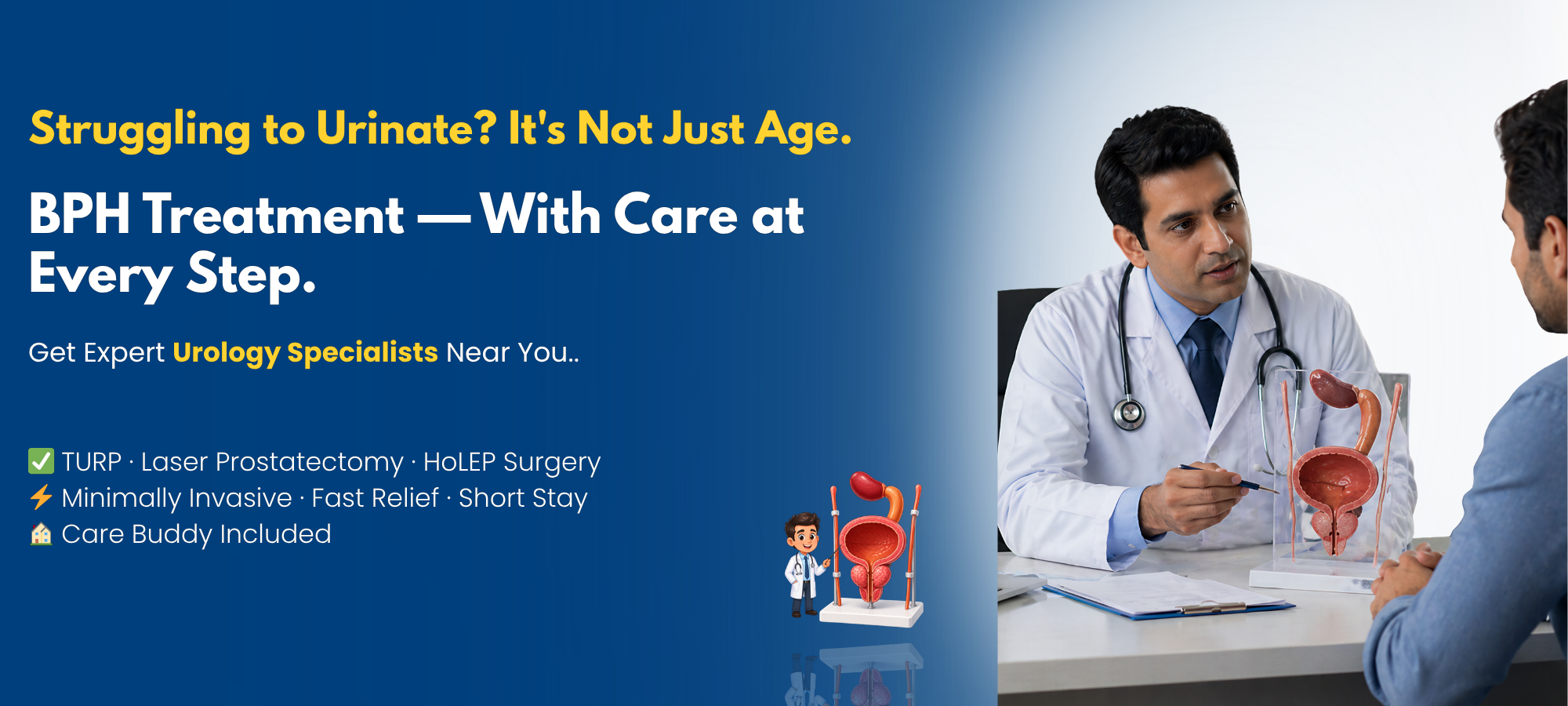
Prostate Enlargement (BPH) Treatment in Hyderabad
Benign prostatic hyperplasia (BPH) — commonly called prostate enlargement — is the most common urological condition in men over 50, affecting approximately 50% of men by age 60 and 90% of men by age 85. SurgiPartner connects patients in Hyderabad with specialist urologists offering the complete range of BPH management — from lifestyle advice and medical therapy to the most advanced laser surgical techniques — restoring normal urinary function and quality of life.


What Is Benign Prostatic Hyperplasia (BPH)?
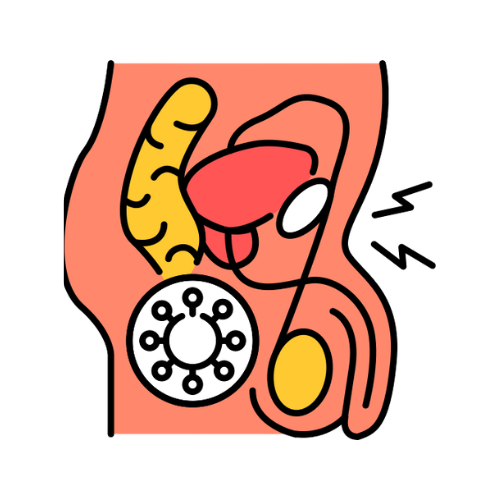
The prostate gland is a walnut-sized gland located below the bladder in men, surrounding the urethra (the tube through which urine passes from the bladder). Its primary function is to produce seminal fluid that nourishes and transports sperm. From approximately age 40, the prostate begins to enlarge under hormonal influences (testosterone and dihydrotestosterone) — a process called benign prostatic hyperplasia.
As the prostate enlarges, it constricts the urethra passing through it, obstructing the outflow of urine from the bladder. The bladder responds by working harder to push urine through the narrowed outlet — thickening its wall and becoming irritable. Over time, if obstruction is not treated, the bladder may decompensate, leading to urinary retention, recurrent UTIs, bladder stones, and ultimately kidney damage.
Important distinction: BPH is not cancer and does not increase the risk of prostate cancer. However, prostate cancer and BPH can coexist — every man with BPH symptoms should have a PSA (prostate-specific antigen) test and clinical evaluation to exclude malignancy.
Symptoms of BPH — Lower Urinary Tract Symptoms (LUTS)
BPH causes two categories of urinary symptoms:
Voiding (Obstructive) Symptoms
- Weak or slow urinary stream – reduced force of urine flow
- Hesitancy – difficulty starting urination, waiting for the stream to begin
- Straining to void – needing to push or bear down to pass urine
- Intermittent stream – urine flow that starts and stops repeatedly
- Terminal dribbling – urine continuing to drip after voiding appears complete
- Incomplete bladder emptying – sensation that the bladder has not fully emptied (post-void residual urine)
Storage (Irritative) Symptoms
- Urinary frequency – passing urine more than 8 times per day
- Urgency – sudden, compelling need to urinate that is difficult to defer
- Nocturia – waking 2 or more times per night to urinate; significantly disrupts sleep quality
- Urge incontinence – leaking urine when unable to reach the toilet in time
Complications of Untreated BPH
- Acute urinary retention – sudden inability to pass any urine; a medical emergency requiring catheterisation
- Recurrent urinary tract infections
- Bladder stones – from concentrated, stagnant urine in the bladder
- Bladder damage – thickening, trabeculation, diverticula
- Kidney damage (hydronephrosis) – from high-pressure, obstructed urine backflow to the kidneys


BPH Diagnosis — Investigations Required
| Investigation | Purpose |
|---|---|
| IPSS Questionnaire | Standardised symptom severity scoring (mild: 0–7, moderate: 8–19, severe: 20–35) |
| Digital Rectal Examination (DRE) | Assesses prostate size, consistency, symmetry; detects suspicious nodules |
| PSA (Prostate-Specific Antigen) | Screens for prostate cancer; elevated in BPH, prostatitis; guides decisions |
| Urine Analysis & Culture | Excludes infection, haematuria, glucose abnormalities |
| Serum Creatinine | Assesses kidney function; elevated in obstructive uropathy |
| Ultrasound KUB + Post-void Residual | Measures prostate size and residual urine volume |
| Uroflowmetry | Measures urine flow rate (Qmax); low flow suggests obstruction |
| Urodynamic Studies | Used in complex cases; differentiates obstruction vs bladder dysfunction |
BPH Treatment — A Stepwise Approach
Step 1: Watchful Waiting (Active Monitoring)
Men with mild symptoms (IPSS <8) and no complications may opt for watchful waiting — lifestyle modifications including reducing evening fluid intake, limiting alcohol and caffeine, double voiding, and treating constipation. Annual review assesses symptom progression.
Step 2: Medical Management
Alpha-blockers (tamsulosin, silodosin, alfuzosin) — relax smooth muscle in the prostate and bladder neck, improving urinary flow within days to weeks. The most commonly prescribed BPH medications. Side effects may include retrograde ejaculation (particularly silodosin) and dizziness.
5-Alpha reductase inhibitors (5-ARIs) (finasteride, dutasteride) — reduce prostate volume by blocking DHT production. Take 3–6 months to achieve full effect but reduce prostate volume by 20–30% over years, reducing long-term risk of urinary retention and need for surgery. Most effective for prostate volumes >30g. Also reduces PSA by approximately 50% — important to factor in cancer screening.
Combination therapy (alpha-blocker + 5-ARI) — more effective than either agent alone for moderate to severe LUTS with enlarged prostate. The MTOPS trial demonstrated that combination therapy significantly reduces the long-term risk of clinical progression.
Phosphodiesterase-5 inhibitors (tadalafil 5mg daily) — approved for BPH and erectile dysfunction; relaxes prostate and bladder smooth muscle.
Anticholinergic/beta-3 agonist agents (solifenacin, mirabegron) — added for storage symptoms (urgency, frequency, nocturia) once obstruction is adequately treated.
Step 3: Minimally Invasive Procedures
Urolift (Prostatic Urethral Lift) — small implants are placed through a cystoscope to lift and hold the obstructing prostatic lobes away from the urethra, widening the channel without cutting or heating. No incision, performed under local or general anaesthesia, rapid recovery. Preserves sexual function including ejaculation. Best for prostates without large middle lobes.
Rezūm Water Vapour Therapy — steam (water vapour) is injected directly into the prostate through a cystoscope, destroying excessive prostate tissue. Minimally invasive, office-based procedure, preserves ejaculatory function. Results develop over 3 months as treated tissue is absorbed.
Step 4: Surgery – TURP and Laser Prostatectomy
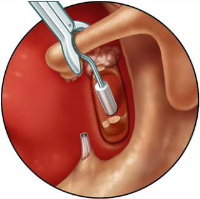
TURP (Transurethral Resection of the Prostate) — the historical gold-standard surgical treatment for BPH. A resectoscope is inserted through the urethra to the level of the prostate. An electrosurgical loop excises prostate tissue in chips (resectate) that are flushed out. TURP effectively relieves obstruction in 85–90% of patients. Requires general or spinal anaesthesia and typically a 2–3 day hospital stay with a catheter.
HoLEP (Holmium Laser Enucleation of the Prostate) — the current gold-standard surgical treatment for BPH of all sizes, particularly large prostates (>80g). The holmium laser is used to enucleate (remove in whole lobes) the obstructing prostatic adenoma from its capsule — the same tissue removal as open prostatectomy but performed transurethrally without any incision. Tissue is morcellated inside the bladder and removed. HoLEP advantages: minimal bleeding (safer for anticoagulated patients), 1–2 day hospital stay, catheter removed in 24 hours, durable results regardless of prostate size, no size limit.
GreenLight Laser (PVP – Photoselective Vaporisation of the Prostate) — uses a 532nm KTP or LBO laser to vaporise (not cut) prostate tissue, sealing blood vessels simultaneously. Excellent for patients on anticoagulation due to minimal bleeding. Similar efficacy to TURP for moderately enlarged prostates.
BPH Treatment — A Stepwise Approach
Why Choose SurgiPartner?
Choosing SurgiPartner means choosing advanced urology care with compassion and precision.
01.
Experienced Urologists
Our specialists have extensive experience treating prostate enlargement using both medical and surgical approaches.
02.
Minimally Invasive Techniques
We use modern laser and minimally invasive procedures that reduce bleeding, pain, and recovery time.
03.
Personalized Treatment Plans
Each patient receives a customized treatment strategy based on prostate size, symptoms, and health needs.
04.
Pain-Free & Fast Recovery
Structured follow-up care ensures lasting symptom relief and improved quality of life.
Request a Consultation
Take the first step toward better urinary health with SurgiPartner Advanced Prostate Enlargement (BPH) Treatment.
Comfort, confidence, and control — that’s the SurgiPartner promise.
View SurgiPartner on Google

Posted on Google
 saikiran challa
Trustindex verifies that the original source of the review is Google.
I am thoroughly impressed with the SurgiPartner model, which delivers integrated, end-to-end patient support across the healthcare continuum—from initial consultations to treatment and surgical interventions, where necessary. I recently availed their Care Buddy service for a consultation, and the experience was highly seamless, efficient, and professionally managed. The structured Care Buddy support, combined with well-aligned financial assistance processes, significantly enhances the overall patient journey. This holistic and patient-centric approach effectively streamlines access to quality healthcare, making it more efficient and convenient in today’s dynamic environment.Posted on Google vasantha kumari buggalaI’m really impressed with the SurgiPartner concept. They provide end-to-end patient support—from doctor consultations to treatment and even surgery when required. I personally used their Care Buddy service for a consultation, and it was a smooth and positive experience. The Care Buddy assistance, along with support in financial processes, makes healthcare much more convenient, especially in today’s fast-paced lifestyle.Posted on Google
 krishna nayakMy Brother Arun Kumar and krishna from Bangalore. We are travelled to Hyderabad for LASIK surgery, and today we successfully underwent the procedure at American Laser Eye Hospital. The surgery went very smoothly and I am feeling very good after the procedure. The hospital environment is very clean and well maintained. All the staff and doctors are very polite, supportive, and professional. A special thanks to SurgiPartner CareBuddy for guiding and helping me throughout the entire process. From the beginning till the end of the day, they were with us at every step and provided excellent support. Overall, I had a very good experience and I highly recommend American Laser Eye Hospital for LASIK surgery with SurgiPartner support.Posted on Google
 ManaswiReally impressed with the concept of SurgiPartner. They offer complete patient support from doctor consultation to treatment and surgery if needed. I personally took a consultation through their Care buddy, and it was a great experience. The care buddy system and help with financial processes make healthcare much easier, especially in today’s busy world.Posted on Google
 Arun NayakMy name is Arun Kumar and I am from Bangalore. I traveled to Hyderabad for LASIK surgery, and today I successfully underwent the procedure at American Laser Eye Hospital. The surgery went very smoothly and I am feeling very good after the procedure. The hospital environment is very clean and well maintained. All the staff and doctors are very polite, supportive, and professional. A special thanks to SurgiPartner CareBuddy for guiding and helping me throughout the entire process. From the beginning till the end of the day, they were with us at every step and provided excellent support. Overall, I had a very good experience and I highly recommend American Laser Eye Hospital for LASIK surgery with SurgiPartner supportPosted on Google
 Shankar S ShankruThank you for the support and service provided by SurgiPartner. The overall experience was smooth and the team was very helpful.Posted on Google
 Thejasree KStaff is very good and nice receiving. They are very humble and their response is very good. Thank youPosted on Google
 Srihari ReddyI want to thank Surgipartner for all the help and support during my LASIK surgery. From the beginning till the end, the team was very proactive with follow-ups and guided me clearly through every step, which made the whole experience easy and stress-free. I would especially like to appreciate CareBuddy Raju and Coordinator Anusha for their outstanding support. They were always in touch with both the hospital staff and me, helped reduce waiting time, and made sure everything went smoothly. Their care, quick responses, and constant guidance really made a big difference. Overall, I had a very positive experience and truly appreciate the support provided by Surgipartner.Verified by TrustindexTrustindex verified badge is the Universal Symbol of Trust. Only the greatest companies can get the verified badge who has a review score above 4.5, based on customer reviews over the past 12 months. Read more
How SurgiPartner Supports You — From First Call to Full Recovery
Follow your step-by-step guide to a successful surgery and recovery, with our expert team supporting you all the way.
Find Doctor & Hospital Support
Fill in your details and we'll call you back to confirm your slot.