Relieve Nerve Pressure. Restore Spine Health. Move Without Pain
Spine Surgeons & Minimally Invasive Care
Disc Injury Treatment in Hyderabad
Disc injuries including slipped disc, herniated disc, bulging disc, and degenerative disc disease are among the most common causes of back and neck pain, affecting millions of Indians. SurgiPartner connects patients across Hyderabad with experienced orthopaedic and spinal surgeons offering the complete spectrum of disc injury treatment from physiotherapy and pain injections to minimally invasive microdiscectomy and spinal fusion. Call +91 9030053009for a free consultation.


Understanding Spinal Discs Anatomy and Function
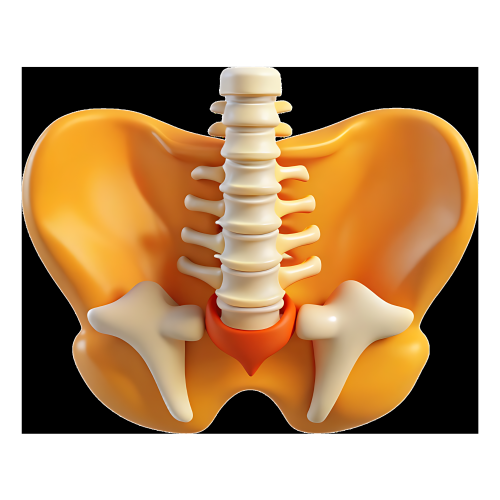
The spine consists of 33 vertebrae separated by 23 intervertebral discs circular structures acting as shock absorbers and flexible spacers between each vertebra. Each disc has two components: a tough outer ring called the annulus fibrosus and a soft, gel-like inner core called the nucleus pulposus. Healthy discs allow the spine to bend, flex, and twist while protecting the vertebrae from impact forces during daily activities.
As discs age or sustain injury, the annulus fibrosus weakens and may crack or tear. When the nucleus pulposus bulges or pushes through these tears, it can compress nearby spinal nerve roots producing the characteristic pain, numbness, and weakness that disc injuries cause.
Types of Disc Injury Complete Classification
1. Conservative Management (Watchful Waiting + Medical Expulsive Therapy)
Small stones under 5–6mm in the ureter have a good chance of passing spontaneously.
Medical expulsive therapy with alpha-blockers (tamsulosin) relaxes the ureteric smooth muscle, increasing spontaneous stone passage rates to 70–80% for distal ureteric stones under 5mm.
Adequate hydration (2.5–3 litres per day), pain management, and regular follow-up imaging are required.
Expectant management is only appropriate if there is no infection, adequate urine flow is maintained, and pain is controlled.
2. ESWL — Extracorporeal Shock Wave Lithotripsy
ESWL is a completely non-invasive procedure where high-energy shock waves are focused on the kidney stone from outside the body, fragmenting it into smaller pieces that pass in the urine over days to weeks.
No anaesthesia or incision is required — the patient lies on a treatment table for 45–60 minutes.
ESWL is most effective for stones 5–15mm in the kidney or upper ureter with good stone density.
Multiple sessions may be required. Stone-free rates are 70–80% for appropriately selected patients.
3. URSL — Ureteroscopy with Laser Lithotripsy
A thin, flexible or semi-rigid ureteroscope is passed through the urethra and bladder into the ureter under direct vision — no incisions required.
A Holmium laser is used to pulverise the stone into fine dust or fragments that pass or are removed.
URSL is the first-line treatment for ureteric stones of all sizes and renal stones up to 15–20mm.
Stone-free rates exceed 90%. A temporary ureteric stent (JJ stent) is usually placed and removed after 1–4 weeks.
4. RIRS — Retrograde Intrarenal Surgery
RIRS uses a flexible digital ureteroscope to access all parts of the kidney through natural urinary pathways — completely scar-free.
Combined with laser lithotripsy, it is effective for renal stones 15–25mm and difficult lower pole stones.
Stone-free rates reach 85–95%. Recovery is fast, usually within 1–2 days, with temporary stent placement.
5. PCNL — Percutaneous Nephrolithotomy
PCNL is the standard treatment for large renal stones over 20mm, staghorn calculi, and complex stones.
A small incision is made in the back, and instruments are inserted directly into the kidney to break and remove stones.
Mini-PCNL techniques reduce bleeding and recovery time.
Stone-free rates exceed 90% for large stones.
Symptoms of Disc Injury — Recognising the Warning Signs
a. Lower back pain — often the first symptom; may be dull, aching, or sharp; worsens with sitting, bending, and coughing
- b. Sciatica — shooting, burning, or electric pain radiating from the lower back through the buttock and down the leg to the foot; caused by compression of the sciatic nerve (L4-S1 roots)
- c. Numbness and tingling — in the leg, foot, or toes (lumbar disc) or arm, hand, or fingers (cervical disc)
- d. Muscle weakness — difficulty raising the foot (foot drop) or weakness in the hand (cervical disc)
- e. Neck pain with arm radiation — cervical disc herniation causing cervical radiculopathy
- f. Cauda equina syndrome — medical emergency: bilateral leg weakness, saddle anaesthesia (numbness around groin and inner thighs), and loss of bladder or bowel control. Requires immediate emergency surgery
Diagnosis of Disc Injury
- a. MRI (Magnetic Resonance Imaging) — the gold-standard investigation for disc injury. Provides precise visualisation of disc morphology, nerve root compression, and spinal cord involvement without radiation
- b. CT scan — useful for bony detail, spinal stenosis assessment, and when MRI is contraindicated
- c. X-ray — shows disc height loss and vertebral alignment but cannot visualise soft tissue disc material
- d. Nerve conduction studies (NCS) and EMG — quantifies nerve and muscle function; useful to localise nerve root compression level
- e. CT myelogram — contrast injected into the spinal fluid space; used when MRI is contraindicated (pacemaker, metal implants)


Disc Injury Treatment — Conservative to Surgical
Step 1: Conservative Management (First 6 Weeks)
The majority of disc herniations (80–90%) improve with conservative treatment within 6–12 weeks.
The disc fragment is gradually reabsorbed by the body. Conservative measures include relative rest
(avoiding aggravating activities), prescribed analgesics and anti-inflammatory medications, physiotherapy
with targeted core strengthening and postural correction, and hot/cold therapy.
Step 2: Interventional Pain Management
Epidural steroid injections (ESI) deliver corticosteroid medication directly around the inflamed nerve root,
reducing inflammation and providing significant pain relief for 6–12 weeks. Transforaminal ESI targets the specific
nerve root level under fluoroscopic guidance and is the most precise technique. Typically 1–3 injections are given.
ESI facilitates physiotherapy participation by reducing pain.
Nerve root blocks — selective injection at the specific exiting nerve root for diagnostic and therapeutic purposes.
Step 3: Surgical Treatment
Microdiscectomy — the gold-standard surgical treatment for lumbar disc herniation causing sciatica that fails
conservative management. A microscope-assisted small incision (2–3cm) allows precise removal of the herniated disc fragment
compressing the nerve root, with minimal disruption to surrounding muscles and bone. Day-care or 1-night stay. Return to
work in 2–6 weeks. Symptom relief in over 90% of patients.
Anterior Cervical Discectomy and Fusion (ACDF) — for cervical disc herniation causing radiculopathy or
myelopathy. The disc is removed through a small neck incision, and the vertebrae are fused with a bone graft and plate.
Highly effective for cervical nerve root compression with success rates over 90%.
Cervical Disc Replacement (Arthroplasty) — an artificial disc implant maintains cervical motion instead
of fusion. Preserves adjacent disc health long-term. Suitable for single-level cervical disc herniation in appropriately
selected patients.
Endoscopic discectomy — a fully endoscopic technique using 7–8mm incisions with a working channel
endoscope. Minimal muscle damage, performed as day surgery, fastest recovery. Requires advanced surgical expertise.
| Procedure | Indication | Approach | Hospital Stay | Recovery |
|---|---|---|---|---|
| Microdiscectomy | Lumbar disc herniation + sciatica | Posterior, open (microscope) | 1 night | 2–6 weeks |
| Endoscopic Discectomy | Lumbar disc herniation | Endoscopic, 7–8mm incision | Day care | 1–2 weeks |
| ACDF | Cervical disc herniation | Anterior neck incision | 1–2 nights | 4–8 weeks |
| Cervical Disc Replacement | Single-level cervical disc | Anterior neck incision | 1–2 nights | 4–6 weeks |
| Epidural Steroid Injection | Radiculopathy, sciatica | Fluoroscopic guided injection | Day procedure | Same day |
Disc Injury Treatment — Conservative to Surgical
After disc injury treatment — surgical or conservative — a structured rehabilitation programme is essential for full recovery and prevention of recurrence. Core strengthening exercises stabilise the lumbar spine, reducing disc loading. Postural correction education teaches patients to protect their spine during daily activities. Ergonomic workplace assessment prevents aggravating factors. Weight management reduces disc loading forces. Smoking cessation improves disc nutrition and healing.
Frequently Asked Questions — Disc Injury Hyderabad
Why Choose SurgiPartner?
Choosing SurgiPartner means choosing expert spine care backed by advanced technology and compassionate support.
01.
Expert Spine Surgeons
Our specialists have extensive experience in treating complex disc injuries and spine conditions.
02.
Advanced Minimally Invasive Spine Technology
We use modern endoscopic and microscopic techniques for precise nerve decompression.
03.
Personalized Treatment Plans
Every spine condition is unique. We tailor treatment and rehabilitation based on your lifestyle and recovery goals.
04.
Pain-Controlled & Faster Recovery
Most patients experience rapid pain relief and return to normal activities within weeks.
Book Your Consultation
Take the first step toward a pain-free spine with SurgiPartner advanced disc injury treatment. Our experts are here to guide you through safe, effective, and lasting care.
Clear vision isn’t a dream anymore – it’s a SurgiPartner promise.
View SurgiPartner on Google

Posted on Google
 saikiran challa
Trustindex verifies that the original source of the review is Google.
I am thoroughly impressed with the SurgiPartner model, which delivers integrated, end-to-end patient support across the healthcare continuum—from initial consultations to treatment and surgical interventions, where necessary. I recently availed their Care Buddy service for a consultation, and the experience was highly seamless, efficient, and professionally managed. The structured Care Buddy support, combined with well-aligned financial assistance processes, significantly enhances the overall patient journey. This holistic and patient-centric approach effectively streamlines access to quality healthcare, making it more efficient and convenient in today’s dynamic environment.Posted on Google vasantha kumari buggalaI’m really impressed with the SurgiPartner concept. They provide end-to-end patient support—from doctor consultations to treatment and even surgery when required. I personally used their Care Buddy service for a consultation, and it was a smooth and positive experience. The Care Buddy assistance, along with support in financial processes, makes healthcare much more convenient, especially in today’s fast-paced lifestyle.Posted on Google
 krishna nayakMy Brother Arun Kumar and krishna from Bangalore. We are travelled to Hyderabad for LASIK surgery, and today we successfully underwent the procedure at American Laser Eye Hospital. The surgery went very smoothly and I am feeling very good after the procedure. The hospital environment is very clean and well maintained. All the staff and doctors are very polite, supportive, and professional. A special thanks to SurgiPartner CareBuddy for guiding and helping me throughout the entire process. From the beginning till the end of the day, they were with us at every step and provided excellent support. Overall, I had a very good experience and I highly recommend American Laser Eye Hospital for LASIK surgery with SurgiPartner support.Posted on Google
 ManaswiReally impressed with the concept of SurgiPartner. They offer complete patient support from doctor consultation to treatment and surgery if needed. I personally took a consultation through their Care buddy, and it was a great experience. The care buddy system and help with financial processes make healthcare much easier, especially in today’s busy world.Posted on Google
 Arun NayakMy name is Arun Kumar and I am from Bangalore. I traveled to Hyderabad for LASIK surgery, and today I successfully underwent the procedure at American Laser Eye Hospital. The surgery went very smoothly and I am feeling very good after the procedure. The hospital environment is very clean and well maintained. All the staff and doctors are very polite, supportive, and professional. A special thanks to SurgiPartner CareBuddy for guiding and helping me throughout the entire process. From the beginning till the end of the day, they were with us at every step and provided excellent support. Overall, I had a very good experience and I highly recommend American Laser Eye Hospital for LASIK surgery with SurgiPartner supportPosted on Google
 Shankar S ShankruThank you for the support and service provided by SurgiPartner. The overall experience was smooth and the team was very helpful.Posted on Google
 Thejasree KStaff is very good and nice receiving. They are very humble and their response is very good. Thank youPosted on Google
 Srihari ReddyI want to thank Surgipartner for all the help and support during my LASIK surgery. From the beginning till the end, the team was very proactive with follow-ups and guided me clearly through every step, which made the whole experience easy and stress-free. I would especially like to appreciate CareBuddy Raju and Coordinator Anusha for their outstanding support. They were always in touch with both the hospital staff and me, helped reduce waiting time, and made sure everything went smoothly. Their care, quick responses, and constant guidance really made a big difference. Overall, I had a very positive experience and truly appreciate the support provided by Surgipartner.Verified by TrustindexTrustindex verified badge is the Universal Symbol of Trust. Only the greatest companies can get the verified badge who has a review score above 4.5, based on customer reviews over the past 12 months. Read more
How SurgiPartner Supports You — From First Call to Full Recovery
Follow your step-by-step guide to a successful surgery and recovery, with our expert team supporting you all the way.
Find Doctor & Hospital Support
Fill in your details and we'll call you back to confirm your slot.